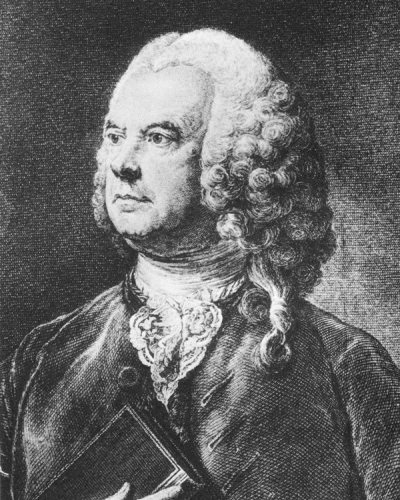
Renowned for his absolute pursuit of precision, Julien Le Roy is rightly considered one of the greatest French watchmakers in history. A precocious genius, he successfully synthesized two opposing watchmaking cultures, French and British, notably by paying tribute to the great English names in the field. This famous watchmaker is also known for having invented the horizontal building clock.
Julien Le Roy, a Precocious Genius
This young man, born in Tours in 1686, was a phenomenon. Indeed, at the age of 13, Julien Le Roy was already crafting small works of his own invention, demonstrating a rare intelligence and an equally remarkable finesse. The young boy quickly dedicated these singular aptitudes for mechanics to a major art form, which once brought glory to the nation, but whose splendor had shifted to the English: watchmaking.
Having moved to Paris to perfect his skills in timepiece mechanics, Julien Le Roy joined the capital’s very exclusive guild of master watchmakers at just 27 years old. He quickly became known for his talents and his particularity: his almost obsessive pursuit of absolute precision, which first led him to perfect existing mechanisms before designing his own. He thus tackled repeater watches, significantly reducing their volume while simultaneously improving both their robustness and precision.
Beating the English at Their Own Game
At the time, the English dominated watchmaking: their masters in the field certainly demonstrated undeniable technical superiority. Julien Le Roy would help reverse this trend, but without any intention of harm. As his reputation grew across Europe, rather than confronting his British rivals, the young man chose to pay tribute to them.
In 1728, he had one of the cylinder watches designed by George Graham, for whom he held great admiration, brought to Paris. (Graham, in turn, did not hide his enthusiasm for his French colleague, whose improvements to repeater watches he particularly appreciated.) He also borrowed Newton’s findings from his work on fluids to apply them to watch balances, thereby significantly reducing friction and thus the wear and tear on mechanisms.
The British, nevertheless, were defeated when Julien Le Roy’s name replaced those of the English watchmakers engraved on Geneva watches.
Watches and Clocks
In 1739, appointed watchmaker to Louis XIV, Le Roy moved into the Louvre. From then on, he dedicated himself to perfecting clocks. He designed various types of clocks with seconds and equations, each time with absolute precision. He developed a compensation mechanism that allowed them to be unaffected by the effects of heat or cold.
Above all, he revolutionized the field of public clocks by inventing a horizontal model for buildings, which was simultaneously cheaper, easier to manufacture, and much more precise. This clock, designed with a new arrangement of gears, Julien Le Roy chose to enhance with several recent inventions, including the universal dial with a compass and pinnules. Among the many advantages of the horizontal clock compared to the old model, it is worth noting that fewer parts are needed for its manufacture, friction is reduced, and construction and maintenance are simplified. The master would detail the secrets of its design in a work published in 1737, *Règle artificielle du temps*.
But Le Roy was not merely a watchmaking genius, one of the most important in his country; he was also a good man. Not only did he ensure that his colleagues could benefit from his knowledge and experience, but he also generously distributed his earnings to the workers in his workshop to reward their labor, to such an extent that he left only a meager inheritance upon his death.
Julien Le Roy passed away in Paris in 1759. His son Pierre Le Roy, who took over the workshop, would in his time be considered one of the fathers of modern chronometry.
His Inventions
In Julien Le Roy’s career, inventions intertwined with improvements. Here is a selection:
In 1720, before the Academy of Sciences, he presented an equation clock marking true time, sunrise, and declination – an invention his audience judged wonderfully accurate and practical.
Around 1721: he invented an adjustable potence for the verge escapement wheel, which is found in most escapements of this type until the end of the 18th century.
In 1744, he removed the bezel from watch cases and placed the striking mechanism beneath the dial.
In 1755, he developed a new striking train using the lever escapement as a moderator.
Among other things, Julien Le Roy is sometimes credited with inventing: blade gongs (which allow for flatter mechanisms), so-called ‘à toc’ repeaters (in which the hammer strikes a block fixed to the case), or the miniaturized lever escapement to regulate the striking speed of clocks. This list is undoubtedly not exhaustive, but documents are lacking to attest to all the memorable achievements of this great man.