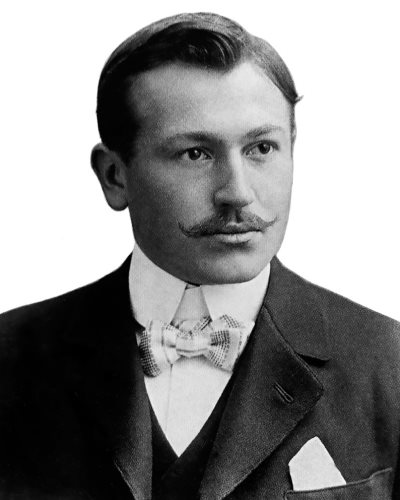
A famous quote by Hans Wilsdorf perfectly encapsulates the man he was: “We want to be the first, and Rolex will be considered the number one brand, the best.” It is not enough to say that history proved him right, with Rolex becoming a worldwide benchmark. It is about understanding how the man managed to bring his ambitions to life through hard work and innovation, while maintaining a degree of mystery about his personal life and becoming one of the most famous watchmakers.
The Hans Wilsdorf Mystery
An innovative spirit, a visionary man… There is no shortage of superlatives when discussing Hans Eberhard Wilhelm Wilsdorf. However, while these terms highlight the discreet genius of a pillar of 20th-century watchmaking, they do not shed light on the private life of the Rolex brand’s founder. The man is, indeed, quite mysterious, almost as much as the – necessarily magical – functioning of his watches, which are marvels of precision.
Readers consulting his official biography published by Rolex must content themselves with four austere lines mentioning four major dates – his birth in Bavaria in 1881, the creation of his own company in London in 1905, the invention of the Rolex brand in 1908, and his death in 1960. Period. For the rest, one must delve deeper and go back in time to learn that Hans Wilsdorf was born to Protestant parents in Roman Catholic Bavaria, in Kulmbach, that he was the youngest of three children, and that he became an orphan at the age of twelve.
After finishing his studies in Switzerland, he was hired as a clerk in a watchmaking firm there, before emigrating to London in 1903. It was there, two years later, at the age of 24, that he founded his own company, Wilsdorf & Davis, with financial assistance from his brother-in-law James Davis, husband of his sister Ana. The company imported watch movements manufactured in Bienne, Switzerland, as a guarantee of quality for the design of its own watches. Wilsdorf’s entire project was based on a bold gamble: to produce highly precise yet affordable wristwatches, at a time when pocket watches still held sway. It paid off handsomely, as his creations quickly spread throughout the British Empire. In 1908, he conceived the new name for his brand, five letters that would become the most famous in watchmaking: Rolex.
The outbreak of the First World War in 1914 changed the situation. Wilsdorf fully experienced the rising anti-German sentiment in England. However, it was primarily tax reasons that prompted him to relocate to Bienne, Switzerland, to escape the 33% import tax imposed by the British government. Rolex SA then moved to Geneva in 1919. More than two decades later, in 1946, he would also found his second brand there, Tudor.
The rest of Wilsdorf’s life merged with the evolution of the Rolex range, as if his existence had only beaten to the rhythm of timepieces. For instance, a brilliant marketing move was conceived at the height of the Second World War, when he sent Rolex watches to British officers imprisoned by the Germans, across the Swiss border, with invoices to be settled after the end of the conflict (a discreet way, moreover, to show his allegiance to the Allies while distancing himself from the Nazi regime). Another example is the creation of the Hans Wilsdorf Foundation in 1944, after the death of his wife, a foundation largely dedicated to charitable works and to which he bequeathed all his shares in the Rolex company.
Rolex, or the Creation of the World’s Most Famous Brand
The history of Rolex is inextricably linked to that of Hans Wilsdorf. For his range of wristwatches, which he intended to launch in the wake of the creation of Wilsdorf & Davis, the German businessman desired a short name, easy to memorize and pronounce in all languages. He already envisioned this name adorning the dials of his watches. Using an alphabet, he tried thousands of letter combinations to find the right one, the most universal, but in vain. It was during a walk in London that the name Rolex was whispered into his ear – by “a genie,” he would say.
To conquer the top spot on the watch podium, Wilsdorf focused on prestige and quality – that of the movements, that of chronometric precision, that of objects manufactured exclusively by hand. In 1910, a Rolex won the first certificate of good functioning ever awarded to a wristwatch, granted by the Bienne Evaluation Center, the Official Swiss Chronometer Testing Institute (COSC). In 1914, another “Class A” precision certificate was issued by the Kew Observatory in Great Britain; this distinction had previously been reserved for marine chronometers. Since then, almost all Rolex production has been subjected to tests to obtain the COSC label. Over time, Wilsdorf would extend this quality requirement by establishing a meticulous after-sales service, carried out by specially trained personnel in dedicated schools.
Rolex is, without a doubt, the number one luxury watch brand. A leading position that, as the years pass, remains unchallenged. A brand that has become a major worldwide benchmark, thanks to its founder. A century after its creation, the brand continues to increase its sales: in 2014, over 780,000 Rolex watches were sold, generating a turnover of 4.35 billion euros.
Of Watches and Men
Hans Wilsdorf was not only a brilliant businessman, the visionary who laid the foundations of modern marketing by communicating targetedly about his products – as proven by the episode of watches sent to imprisoned British officers, a brilliant publicity stunt. He also invented timepieces of unparalleled quality and precision, which accompanied their wearers on exceptional human adventures.
In 1926, he designed the Rolex Oyster, the first truly waterproof watch, featuring a hermetically sealed case.
In 1931, he invented the self-winding Rolex Perpetual. This system, which winds itself with simple wrist movements, is the origin of all similar mechanisms found in today’s watches.
In 1945, the Datejust was launched: not only was it the first self-winding wristwatch to also offer a chronometer complication, but as another innovation, a window on the dial displayed the date.
These Rolex models were not – and never have been – merely leisure watches. Very early on, their unique performance was embraced by athletes and scientists, de facto transforming them into companions for the most incredible challenges of the first half of the 20th century. Wilsdorf did not fail to take advantage of these various real-world situations, using them as living laboratories to test the technical prowess of his timepieces. For example, note that:
In 1927, the Englishwoman Mercedes Gleitze swam across the English Channel wearing a Rolex Oyster on her wrist, definitively proving its perfect water resistance after 10 hours of immersion.
In 1933, the first flight over Everest was carried out by a crew wearing Rolex Oyster watches.
In 1935, racing driver Malcolm Campbell wore a Rolex watch when he set a land speed record in Utah, exceeding 485 km/h, at the wheel of a Bluebird.
In 1953, when Everest was conquered by John Hunt’s team, several of the mountaineers present wore Rolex watches. The same year, to celebrate the event and capitalize on this success, Wilsdorf launched the Oyster Perpetual Explorer.
In fact, in the 1950s, Rolex embraced this popularity and designed professional watches, intended for use in extreme activities: aviation, mountaineering, scientific exploration, scuba diving, etc. The watches for extraordinary feats were born.
Rolex has never lost its splendor. But more than just a symbol of social success (to which advertiser Jacques Séguéla hastily reduced it with an unfortunate phrase), Rolex has always been, and will undoubtedly remain for a long time, a materialization of the high precision and reliability of Swiss watchmaking.