Who was Daniel Jeanrichard? Documents are so scarce that it is difficult to distinguish between fact and fiction, to separate reality from the mythologization that quickly surrounded the man after his death. What is certain is that this self-taught genius, who always lived in the Swiss Jura mountains, remained a tutelary figure of the Neuchâtel watchmaking industry, which he helped to emerge. This famous watchmaker had only his talent and an undeniable gift for innovation as his tools.
A Mysterious Self-Taught Man Named Daniel Jeanrichard
Due to insufficient documentation (see the official website dedicated to the master), Daniel Jeanrichard’s exact role in the advent of the Neuchâtel watchmaking industry, as well as the precise reasons that led him to enter the Pantheon of timepiece manufacturers, remain poorly understood.
It is known that the man was born in 1665 in a hamlet in the Swiss Jura named Les Bressels, located somewhere between La Chaux-de-Fonds and Le Locle, and that he very early on showed all the hallmarks of an inventive and curious mind. It is said that the young man, devoid of experience in watchmaking, an art that did not exist in the Jura mountains, was one day entrusted by a horse merchant returning from London with an English watch whose mechanism had stopped along the way.
Why did the traveler think of entrusting this high-precision object to the young boy? While visiting the Jeanrichards, whose father he knew well, he noticed the presence of many small works that the family owed to Daniel’s manufacturing talents. Daniel set about the task and managed to repair the timepiece, but not without carefully examining its mechanism.
Armed with this knowledge, Daniel Jeanrichard was able, in 1681, at barely 16 years old, to design his own watch, an almost identical reproduction of the model he had repaired for his father’s friend. This was the very first watch ever made in the Neuchâtel region, and the result of a challenge all the more incredible given that no one, before the merchant’s arrival, had ever seen the equivalent of this accessory. To achieve this, Daniel was forced to imagine and design all the tools and machines necessary for manufacturing, in order to reproduce the delicate parts of the mechanism. In total, it took him a year and a half of work.
The Roots of Modern Watchmaking
Such genius did not go unnoticed, and soon, all the neighbors, then the inhabitants of the region, were ordering watches from Daniel. He dedicated himself to developing his talents by learning engraving and gilding, went on a pilgrimage to Geneva to perfect his art, and returned to La Sagne where he founded his watchmaking workshop, before settling in Le Locle.
For years, he remained the sole watchmaker in the Swiss Jura. That is why, before his death on April 20, 1741, he took care to train his five sons in watch design; and they themselves would disseminate their father’s expertise to young apprentices, until, under their patronage, the Jeanrichard workshop became a flourishing enterprise. Among his descendants, it was his grandson Louis who would be remembered as one of the best watchmakers of his generation.
However, Daniel Jeanrichard’s legacy does not end there. By establishing his workshop in La Sagne, then in Le Locle, by disseminating his knowledge so that it could be shared by all, and by fostering the emergence of a surprisingly modern distribution of labor, particularly through the division of tasks, Jeanrichard challenged (whether intentionally or not) the dominance of Geneva watchmakers over this art. At that time, a particularly powerful Guild of Watchmakers flourished in Geneva, jealously protecting its expertise in watch manufacturing. To produce excellent timepieces, but in small quantities to maintain exorbitant prices, the Guild members controlled and centralized production.
However, Daniel Jeanrichard, in his own way, broke apart this centralized and exclusive system. Through a process called établissage, he introduced the principle of division of labor into watchmaking: he trained the peasants of the Swiss Jura in the manufacture of specific parts belonging to the watch mechanism, then entrusted the assembly to master watchmakers. By creating tools that facilitated production, he increased it and thus encouraged the mechanization of the process; consequently, the number of available watches increased and prices decreased. Finally, to encourage as many people as possible to follow his example, he passionately disseminated his knowledge all around him, paving the way for what can be called a modern watchmaking industry, encompassing both production and apprenticeship. This is how Daniel Jeanrichard paved the way for the future emergence of local personalities such as Abraham-Louis Breguet.
A Mythical Figure
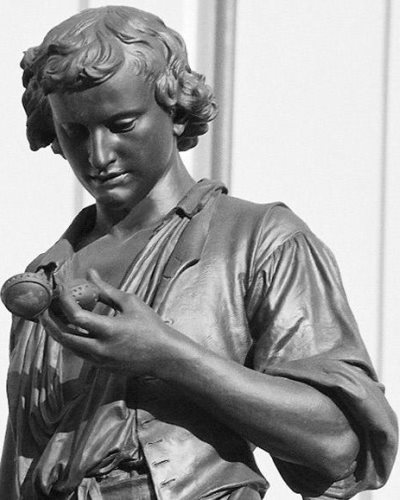
Daniel Jeanrichard’s figure was immediately mythologized after his death and readily cultivated throughout the 19th century, particularly by Swiss watchmakers keen to assert the paternity of the watchmaking industry against Anglo-Saxon competition. To honor him, the municipality of Le Locle inaugurated, on July 15, 1888, a several-meter-high statue depicting him as a local hero.
Since 2012, the luxury watch brand Jeanrichard has experienced a new life, under the guidance of its owner, the Kering group. Although modernized and greatly revitalized, it remains faithful to the virtues of innovation and savoir-faire championed by its founder.
The museum dedicated to him, in La Chaux-de-Fonds, exhibits several exceptional watches designed and manufactured by the master. Notably, one can admire the 1710 “Daniel,” featuring a window calendar, protected by a silver case, and equipped with a verge escapement movement. By lifting the bezel, it is even possible to read the time simply by running one’s finger over the raised indices. In short, a true technical and aesthetic masterpiece that remains the best embodiment of the mysterious genius that was Daniel Jeanrichard.