



Though little known to the general public, German watchmaking has nonetheless gradually built its reputation, relying on distinctly Germanic values of rigor and precision. Spurred by its proximity to its Swiss neighbor, the Teutonic watchmaking industry has developed an alternative offering to the Swiss market, based on an excellent quality-to-price ratio, which has steadily gained momentum in recent years.
German Watchmaking until the 19th Century
The birth of German watchmaking is closely linked to the exodus of Huguenot watchmakers that affected France in the wake of the revocation of the Edict of Nantes in 1685. As a century earlier, Protestant artisans exiled en masse, fearing pogroms, to seek refuge in England, the Netherlands, Switzerland, and thus in Germany, particularly in the city of Pforzheim.
Early 19th-century Germany (which was not yet fully Germany but still Prussia) maintained an unpretentious watchmaking tradition, as was the case in most European countries. For three centuries, astronomical and tower clocks coexisted with traditional pendulum clocks and cuckoos, but nothing more. It was there that Adolph Lange, a discreet artisan, revealed the extent of his talents in Saxony, in the beating heart of German watchmaking, as an apprentice to Friedrich Gutkaes.
After a journey through Swiss and French workshops, from which he gained considerable experience in his craft, Lange took over Gutkaes’ workshop and founded a leading watchmaking manufacture in a somber town in the East of the country, Glashütte. He personally trained the local workers on site, thus contributing to the creation of a training structure called the German School of Watchmaking.

Meanwhile, in neighboring Switzerland, in La Chaux-de-Fonds, it was a Teutonic scion who was responsible for the invention of the low-cost watch – quite a feat! In 1855, Georges-Frédéric Roskopf, along with his son and a watchmaker named Henri Gindraux, founded the company Roskopf, Gindraux & Co., with the ambition of designing men’s timepieces that were easy to manufacture, thus inexpensive, but always of good quality. The Swiss industry did not welcome this innovation, which sought to challenge its hegemony in the luxury sector; but the endeavor at least proved the distinctly Germanic will of watchmakers to innovate in this sector, whether in their own territory or elsewhere.
At the end of the 19th century, Emperor Wilhelm I took charge of national watch production and had the Hamburg Observatory built, inspired by the one in Greenwich, England. Subsequently, the country began to produce its own marine chronometers, leveraging French and English advancements and based on the criteria presented by the Chronometer Conference of 1878. Adolphe Lange launched his first models in 1886.
The race for the German marine clock was on. Grossmann and Strasser & Rhode also produced them, not without copying Lange’s work. Soon, German military watchmaking found its center of gravity in the heart of Glashütte — this would remain the case until German reunification, more than a hundred years later. But chronometers were not the only items to leave Lange’s workshops: the watchmaker, who had focused on miniaturizing his mechanisms, designed a pocket watch model for the military, the Beobachtungsuhr. It was always to adapt to the needs of the armies that watches began to be worn on soldiers’ wrists, abandoning the pocket watch at roughly the same time as in the rest of Europe – that is, between the two World Wars.

A Turbulent 20th Century for German Watchmaking
In the 1930s, Germany, under the sway of its vociferous Chancellor, frantically developed air transport – airplanes and airships – at least until the fire of the most famous and imposing among them, the Hindenburg, in 1937.
Pilots and flight commanders needed to measure time everywhere, all the time, and above all in the air: they required large observation watches, legible in the dark. A bustling activity then began within the country’s watchmaking workshops (Lange, but also Laco, Stowa, or Wempe), all hoping to benefit from the bounty offered by the government in exchange for major advancements in the field of timepieces. The B-Uhr watches emerging from the workshops were successes. But they would not last: the end of the war and the division of the country into two, placing Glashütte in the hands of the communists, would heavily impact the health of German watchmaking for a long time.

In the GDR, indeed, the communists brought watchmaking workshops, considered bourgeois, into line. Independent houses were grouped into an organization typical of the Soviet Union, dedicated to producing identical GUB-branded watches. Watchmakers in the West did not escape this somber atmosphere, as was the case for Stowa, whose stock was partly confiscated by the French military.
It was not until the fall of the Berlin Wall in 1989 that the German economic fabric managed to restructure itself. On this occasion, watch brands came back to life, like Glashütte Original, born from the ashes of GUB, or Lange, re-opened in 1990 by a descendant of its founder. A rediscovered success that gives German watchmaking the air of a ‘Little Switzerland’…

Some German Inventors
Less known than their French, English, or Swiss counterparts, German watchmakers have nonetheless contributed their share of innovations to the watchmaking industry. Here are the most renowned (in chronological order):
- Johann Christian Friedrich Gutkaes
- Friedrich Wilhelm Bessel
- Georges-Frédéric Roskopf (exiled in Switzerland)
- Ferdinand Adolph Lange
- Charles Fasoldt (exiled in the United States)
- Karl Moritz Grossmann
- Jules Grossmann
- Edouard Koehn
- Salomon Arpels
- Hans Wilsdorf
- Matthias Naeschke

Major German Brands
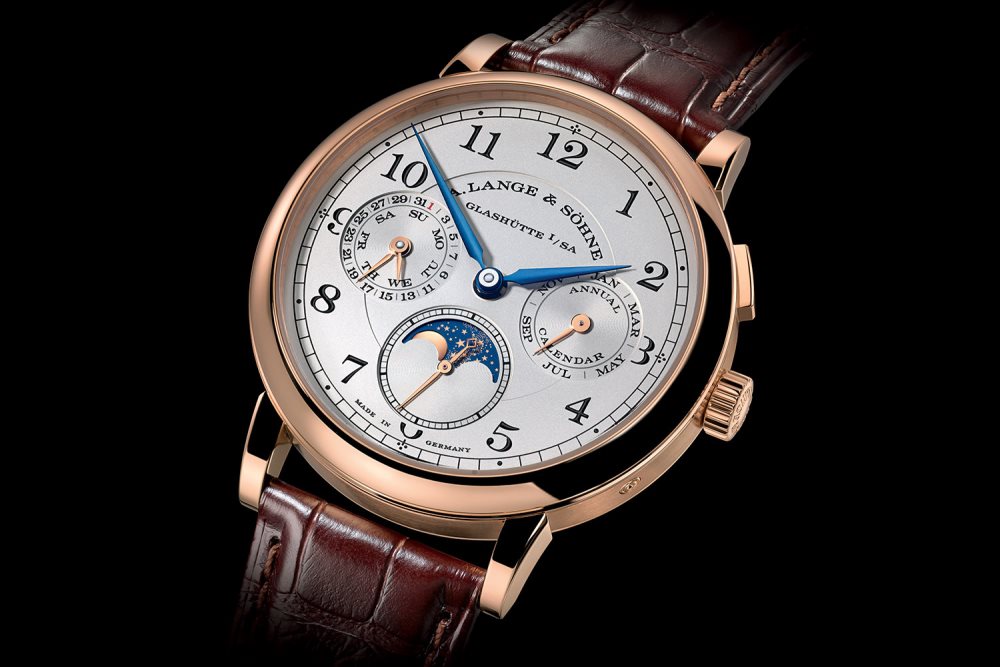
German watchmaking is currently driven by a two-headed industry, located in the East of the country, in Glashütte, where the headquarters of the two largest national brands are adjacent: those of A. Lange & Söhne (belonging to the Richemont group), and Glashütte Original (within the Swatch group). Founded in 1845, A. Lange & Söhne saw its operations halted by World War II and the division of Germany, before a resurrection in 1994. The Glashütte Original brand, for its part, only officially came into being in the early 1990s; but the signature was a guarantee of quality from the mid-19th century.
Other notable German watchmaking brands include: Archimede, launched in 2003 by Ickler; Junghans, which has existed since 1861 and produced up to 3 million watches per year in the early 20th century; Wempe, a jewelry and watch distributor that also ventured into timepiece manufacturing, occupying the mid-range segment; and Nomos, a young brand founded in 1990, offering modern watches influenced by the Bauhaus school.
