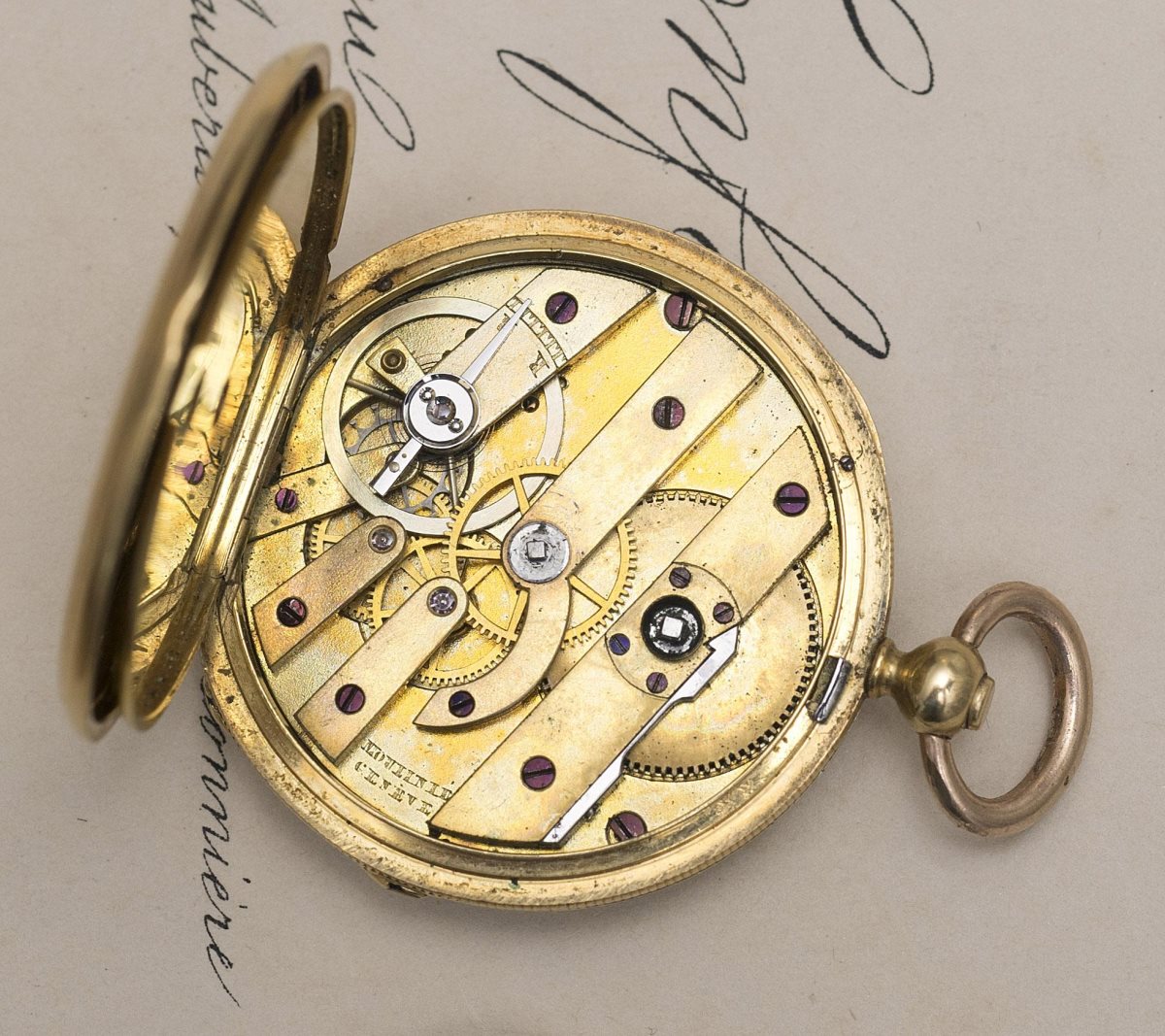
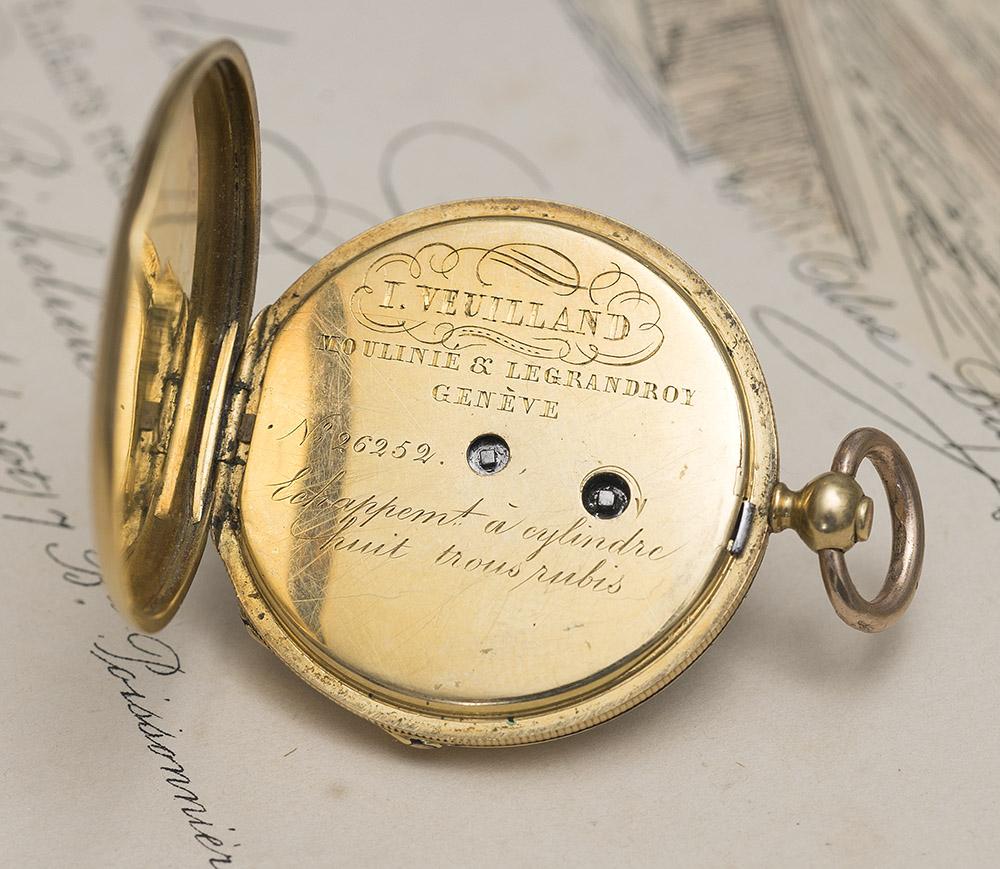
While the classical era saw the miniaturization and refinement of watchmaking mechanisms, as well as the emergence of the watch, the 19th century was marked by a process of industrialization in the sector: industries gradually replaced small artisans. This was the period when the mechanization of labor made large-scale production possible, further democratizing the acquisition and use of timepieces. Discover the history of watchmaking during this period.
Transition towards the Industrialization of Watchmaking
19th-century watchmaking discovered the principles of labor mechanization: machine tools, mass-produced from Europe to the United States, were not intended to replace human activity per se, but rather to limit the risks associated with imprecision, for operations that could not tolerate any kind of error. With this aim of mechanization and industrialization in watchmaking, the firm Vacheron & Constantin created, as early as 1839, a complete series of machine tools dedicated to watch manufacturing. This was the era of the emergence of large watchmaking establishments, such as that of Jean-François Bautte, which, as early as 1830, brought together some 120 artisans and 180 workers across all watchmaking trades.
The timepiece became democratized, but the industrialization of watchmaking was not the sole cause: the inventiveness of artisans led them to conceive models that were both simpler and more attractive, greatly popularizing the use of chronographs. The design, as early as 1810, of the wristwatch by Abraham-Louis Breguet (offered to Caroline Murat, the Queen of Naples), or that, in 1842, of the keyless winding watch by Adrien Philippe, contributed to the universalization of watch usage.
All that remained was to lower the manufacturing cost, consequently reducing the purchase price and allowing more and more people to own one: this is what Georges-Frédéric Roskopf achieved when, in 1867, he produced a watch known as the “worker’s watch” (also called “the Proletarian”); manufactured in La Chaux-de-Fonds, consisting of 57 parts instead of the approximately 200 traditionally required, it was sold at the exceptionally low price of 20 francs. 19th-century watchmaking, through this means, also experienced a form of democratization.
????????????
Competition from across the Atlantic
By the mid-19th century, the Swiss watch surpassed its English counterpart: Swiss production encompassed more than half of the global industry (around 70% by 1870). However, this new status was quickly threatened by the rise of American-style industrialization in watchmaking. Within the framework of a true industrial revolution in watchmaking, mechanization combined with an efficient principle of division of labor (Taylorism) tended to challenge the dominance of Swiss watchmaking establishments.
The Americans demonstrated their expertise, and they proved it. The 1876 Universal Exhibition, held in Philadelphia, Pennsylvania, was marked by the audacious dominance of the world’s first industrial watch manufacturer, Waltham Watch Company, founded in 1850 by Aaron Lufkin Dennison: there one could see the very first automatic screw-making machine, as well as the first assembly line dedicated to watch mechanisms. At the end of the line, randomly selected watches were examined by a duly constituted jury, which awarded Dennison’s firm the gold medal for the first global chronometric competition.
Swiss watchmakers, challenged by articles in specialized journals, were urged to react; they then became aware of the power of the American industry in this field, and in response, Switzerland accelerated its own mechanization process. The industrialization of watchmaking then knew no bounds on either continent.
Universal Time
The 19th century also saw the imposition of Universal Time. The cause: the railway revolution. The technical evolution of trains, with its corollary of greater speed for long-distance travel, made the profusion of local timetables (different from village to village) a real headache not only for train conductors but also for travelers, who could never rely on an exact time. Consequently, in 1847, England imposed a single time across the entire territory, based on London time.
In the United States, the problem was even more pressing, given the great distance separating East and West. The transcontinental railway, completed in the aftermath of the Civil War, stretched for some 4,000 kilometers; how could one rely on Washington time when traveling to San Francisco? In 1876, it was decided to segment the American territory into 5 time zones. These precedents led to the temporal revolution of 1883: during the Congress of Rome, world powers decided to divide the Earth’s circumference into 24 equal zones, separated by a longitude of 15 degrees (i.e., one hour); the starting point was the Greenwich Meridian in England.
The imposition of Universal Time responded, in a way, to the industrial revolution in watchmaking: it was because more and more watches were being manufactured and sold, and timepieces were traveling everywhere, that it became necessary to rely on a single fixed time.
Major Watchmakers of the 19th Century
Notable watchmakers of the 19th century include:
Louis-Benjamin Audemars (1782-1833): an emblematic figure in luxury watchmaking, founder of the Swiss house Louis Audemars & Cie.
Jean-François Bautte (1772-1837): founder, in Switzerland, of the Moulinié & Bautte manufacture (in 1793), which later became Moulinié, Bautte & Cie.
Airy George Bidell (1801-1892): English, director of the Greenwich Observatory, he conducted numerous studies on various watch parts (escapements, gear wheels, the influence of magnetism on chronometers, the “Airy formula” on disturbances affecting an oscillator’s period, etc.).
Friedrich-Wilhelm Bessel (1784-1846): German astronomer and mathematician, he designed the involute pendulum.
Abraham-Louis Breguet (1747-1823): a Swiss adopted by Paris, he improved the so-called “perpetual” watch (which is wound by the wearer’s movements) and developed many of his own inventions (the gong-spring, various escapements, the pare-chute shock protection, the Breguet overcoil, the Tourbillon, the wristwatch, etc.). Although he lived a large part of his life in the 18th century, some of his inventions date from the early 19th century, hence his inclusion in this list.
Georges-Auguste Léschot (1800-1884): Swiss, inventor of the first machines used to manufacture the different parts of a watch, with the aim of producing interchangeable parts.
Louis Monet (1768-1853): (French) inventor of the chronograph.
Adrien Philippe (1815-1894): this French watchmaker partnered with Norbert Patek to found the Patek Philippe house in Geneva. Among other things, he is the inventor of a keyless winding and setting watch.
Georges-Frédéric Roskopf (1813-1889): this German watchmaker invented the watch that bears his name, of quality and accessible to the general public.