Throughout history, human beings have wished to measure the passage of time. In this tireless quest, which led them to design modern clocks and watches, the sundial was the very first step, relying on the path of our bright star in the sky to determine the time of day. Here is its history.
The First Instrument for Measuring Time
Can one even imagine what the invention of the sundial was like? With the help of a rod and a graduated surface, the Ancients had found the most accurate method of their time to tell the hour of the day; and they had conceived the idea by observing the path of the sun in our sky. Certainly, this system could only function during the day, which limited its use. However, the sundial was only supplemented by two mechanisms: the clepsydra and the hourglass, which could not calculate hours, but “only” measure durations.
The Egyptians likely already knew about the sundial, but no description has reached us. Other writings mention the use of this instrument: the Bible refers to the sundial owned by Ahaz, King of Judah, in Jerusalem (8th century BC), Pliny the Elder mentions the one invented by the Greek Anaximander (6th century BC), and Herodotus attests to the use of the gnomon among the Babylonians (around the 5th century BC), a practice that probably dates back to a much older invention, perhaps transmitted to the Egyptians in very ancient times (2nd millennium BC). Using a gnomon to establish the sun’s height, the Greek Eratosthenes used it to demonstrate the Earth’s sphericity.
However, among primitive sundials, it is the one created by Berossus, in Greece, that we know best. In the 3rd century BCE, the Chaldean had invented a vertical sundial composed of a hollow hemisphere, turned towards the earth, and equipped, right in the center of its cavity, with a knob whose shadow, under the sun, marks the hours on the walls of the half-sphere. This type of sundial bears a name: the scaphé (“boat”).
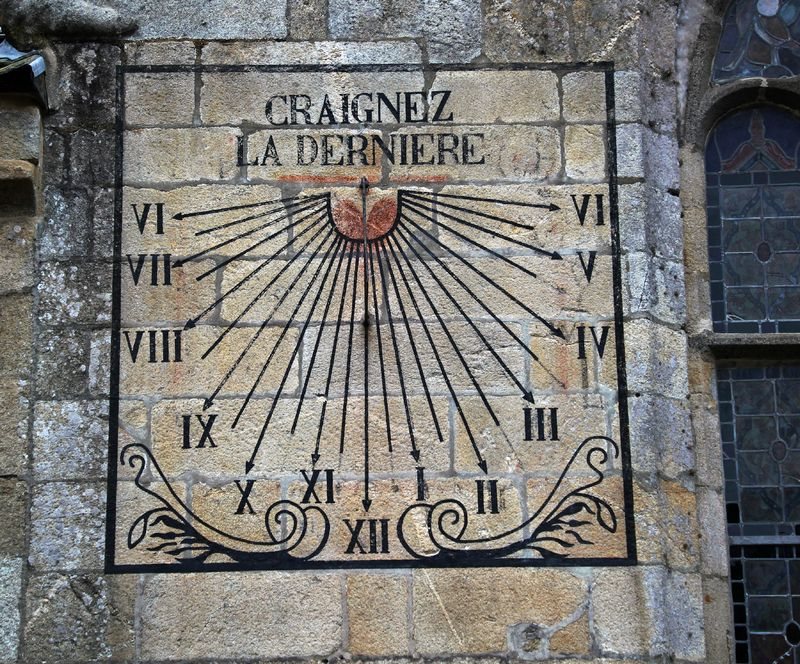
In Europe, churches and monasteries adopted the measurement of time. The canonical sundial, which emerged in the 7th century, was used to indicate to members of the religious community the beginning of liturgical acts; the problem of nighttime hours, however, was circumvented with the help of fire clocks. As for the (questionable) precision of these horizontal sundials, installed perpendicular to the walls of churches, abbeys, and monasteries, it mattered little. Not because approximation would be acceptable, but because the Church made it a point to impose this calculation of hours as perfect.
The sundial, in fact, lacks precision. This is due to an hour that is not constant throughout the year. For the Ancients, the interval between sunrise and sunset always consisted of twelve hours, regardless of the time of year – this is why gnomon dials are graduated twelve times, at equal distances. However, depending on the distance between the celestial body and the Earth, the length of days increases and decreases. As a result, ancient sundials indicated “unequal hours,” or “temporary hours,” varying according to location and season.
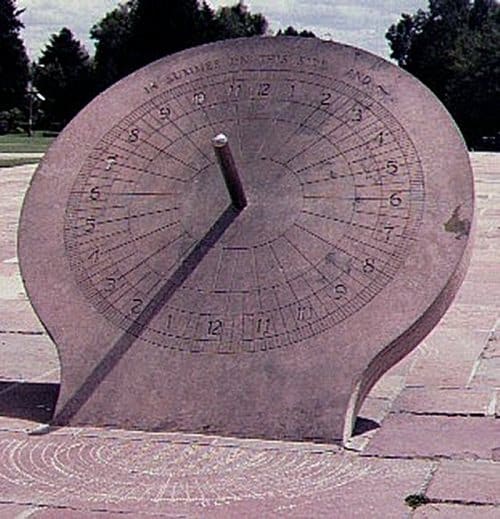
It would be necessary to await the invention of the inclined gnomon to transition to diagrams displaying equal hours. The inclination of the traditional rod stems from an awareness dating back to the 15th century: the fact that the Earth revolves around the Sun. In a way, the effectiveness of the inclined gnomon, also called “polar,” contributed to demonstrating the veracity of the theories supported by scholars such as Copernicus, Kepler, and Galileo: it turned out that by tilting the gnomon to make it parallel to the planet’s axis, the measurement of hours became exact…
The appearance of clocks, towards the end of the 14th century, did not immediately bury the sundial. On the contrary, the two instruments became complementary: the sundial, with its now inclined gnomon, was capable of measuring time with a certain accuracy; and the clock could keep that time. This duo would have many good years ahead of it, before the increasing precision of mechanisms relegated the sundial to museum shelves.
How a Sundial Works: the Gnomon
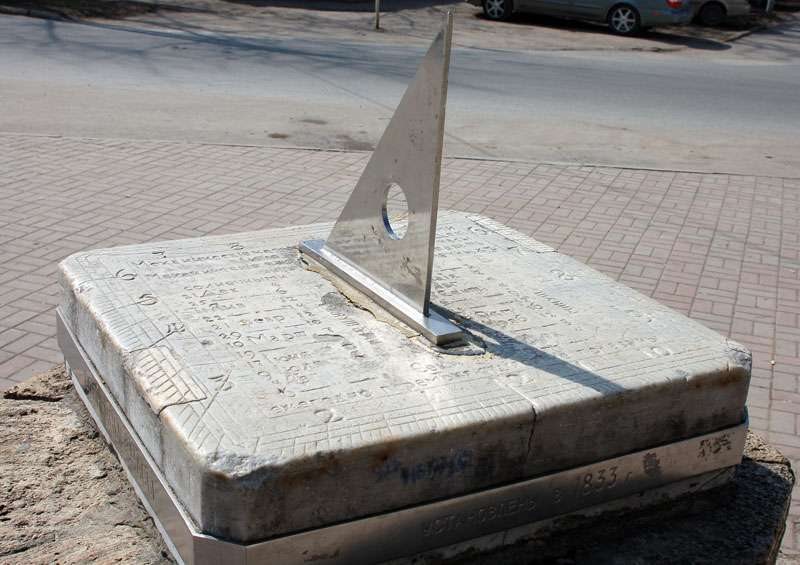
The operation of the sundial is based on that of another instrument: the gnomon, an astronomical tool whose shadow’s length and direction are used to indicate the hours marked on a flat, horizontal surface. The gnomon is the entire device comprising the rod, planted or fixed, always vertically, bearing the name “style,” and the support on which it is placed – in a base or directly in the ground.
In itself, the gnomon aims to establish the sun’s height in the sky, always through its projected shadow. Originally a simple stick planted vertically in the ground, known to the Greeks and Chaldeans, it is at the origin of the science of sundials, called gnomonics. In short, the gnomon is the ancestor of the “modern” sundial reinvented by the Babylonians and Greeks.
How a Sundial Works: the Division of Hours
The principle of the gnomon applies very simply to the sundial: the shadow of the gnomon is cast onto divisions artificially created on the flat surface, indicating the passage of hours. The shadow follows the sun’s path in the sky and progressively moves over each division, much like the hand on a watch dial.
The typical sundial is divided into twelve hours, from sunrise to sunset. But even with the later inclination of the gnomon, the sundial retains its two main drawbacks: it only indicates local time, which changes depending on longitude… and it remains subject to climatic hazards!