In the long history of time-measuring tools, the clepsydra stands as a fundamental milestone: for the first time, a system allowed for the calculation of duration independently of external events, unlike the sundial and gnomon. Over time, from the Egyptians to the most prestigious scholars of Arabia and China, the water clock was perfected to become an increasingly precise and majestic instrument.
Between the Sundial and the Hourglass: the Water Clock
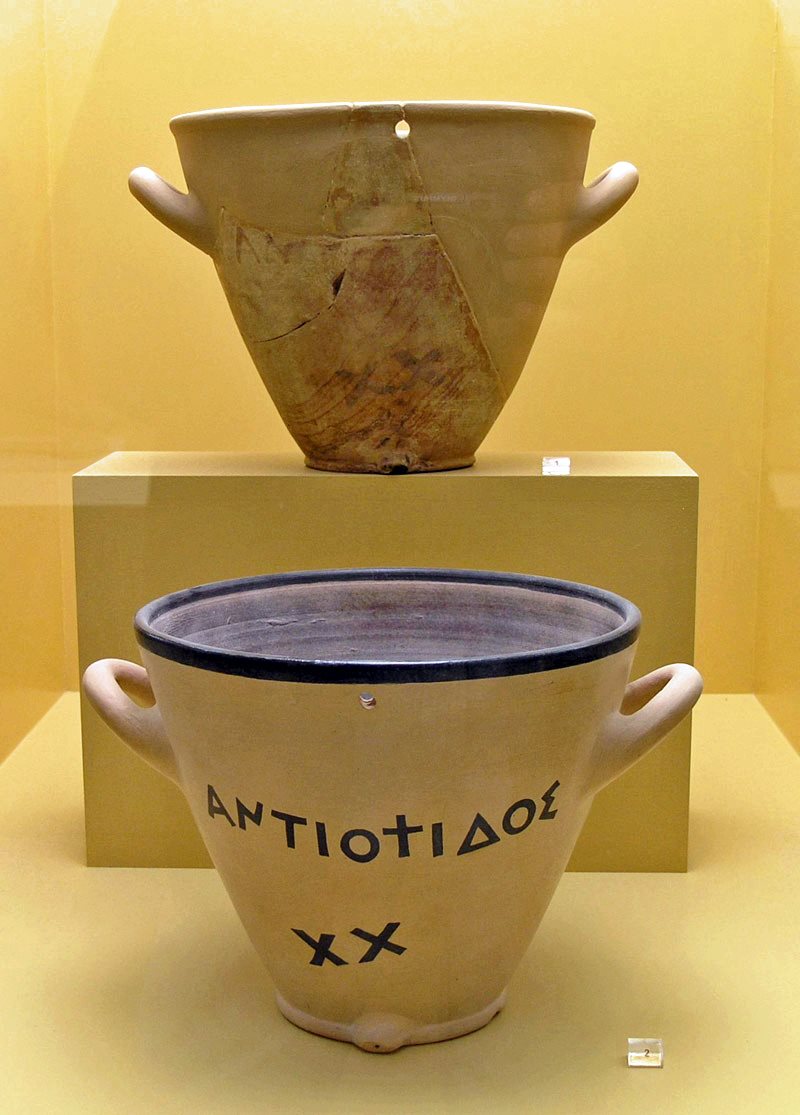
Although older Babylonian tablets already mention the water clock, its first archaeological manifestation dates from around the 15th century BC: a unique specimen was discovered in Karnak, in the Temple of Amun, at the beginning of the 20th century. This is the first known reference to a time-measuring system of this kind, based on the constant flow of a liquid in a conical vase adorned with graduations, with an orifice for the water’s outflow. This water clock is still exhibited at the Cairo Museum.
But it was the Greeks, a millennium later, who elevated the clepsydra to prominence — and even its name, derived from the Greek “klepsydra,” later transformed into “clepsydra” in the Latin world. A word formed from “kleptein” (“to steal”) and “hudor” (“water”), literally meaning “water thief.” Nevertheless, the use of the water clock is also attested among the Gauls, the Chinese, and, on the other side of the Atlantic, among Native Americans.
The clepsydra’s value lies in its ability to measure durations independently of external elements such as the daytime celestial body, which is necessary for the functioning of sundials and gnomons. Capable of functioning in all circumstances, including at night and indoors, the water clock allows for the measurement of brief durations (between 5 and 10 minutes for primitive models) with satisfactory precision. In Greece, it was used to limit speaking time during political speeches and legal pleadings. In the Roman Empire, it served to calculate soldiers’ nocturnal guard shifts.
During the Middle Ages, Arab and Chinese scholars drew inspiration from Greek studies to further perfect the water clock mechanism. Some of their clepsydras remained famous, notably the one offered to Charlemagne by the Caliph of Baghdad, Harun al-Rashid, in 807, adorned with automata that came to life as the water rose in the vase. Or the large water clock, about ten meters high, designed by Su Sung for the Emperor of China in the 11th century — its clock tower was topped with a sphere displaying the position of the stars, which, along with the dials indicating the hour, day, and month, made it the most complex water clock ever invented.
Operating Principle of a Clepsydra
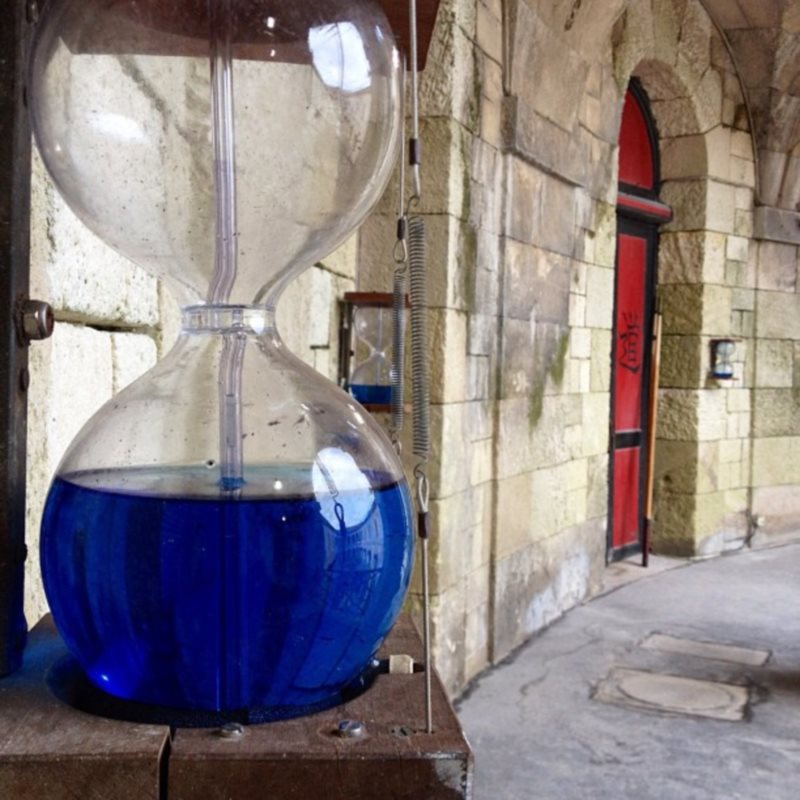
In its most primitive form, the clepsydra, based on the same principle as an hourglass, consists only of a single bowl with a hole at its lowest point, through which water drains. The elapsed duration is measured by graduations engraved inside the container.
Later, it was perfected with two superimposed vases, slightly offset, the upper one having a hole that allows water to flow into the lower one. Inside the latter, approximately equidistant graduations allow for the measurement of time intervals.
These water clock models use conical-shaped vases. Why not cylindrical? Because it is observed that at a constant flow rate, the conical shape is the only one that compensates for the loss of water ejection speed due to the combined effect of the liquid level drop and the associated pressure reduction. The cone offers an approximately equal duration measurement from the bottom of the vase to its rim.
Ctesibius’s Clepsydra: a Step towards Modernity
The Greek inventor Ctesibius evolved the traditional two-vase clepsydra model into a more complex instrument, in which the flow of water became an energy source that allowed for the movement of gears and time indicators. This modernized water clock, which can therefore be described as a true hydraulic clock (it operates in a closed system and this time truly measures time, not just duration), was adopted by the Romans. Here is how it works:
This clepsydra comprises two vases, one elevated, the other below containing a float, a notched rod immersed in the lower vase, and a gear mechanism that allows a hand to turn around a dial. Water is continuously poured into the upper vase, while the surplus is drained by an overflow pipe. Water flows into the lower vase at a constant rate due to the upper vase always being full. As the lower vase fills, the water raises the float, which in turn pushes the notched rod upwards. This rotates the gear mechanism, which indicates the time on the dial via a hand.
Indeed, it was this water clock model that definitively transitioned this instrument into the realm of modern timepieces. The system would be further perfected by the Arabs and Chinese, without undergoing any major revolution in the following centuries.
If you are interested in building a clepsydra, take a look at this page!





 Operating Principle of a Clepsydra
 Ctesibius’s Clepsydra: a Step towards Modernity