

Key takeaway: ATM or meter ratings indicate resistance to static pressure in a laboratory, not actual immersion depth. This distinction is crucial for preserving the movement, as a watch marked “30 meters” only tolerates splashes. For swimming, only a water resistance of 10 ATM, or a theoretical 100 meters, guarantees reliable protection.
You might think your timepiece is ready for a swim because it displays 30 meters, but this common confusion, unfortunately, risks drowning its mechanism. Understanding how watch water resistance and ATM standards work prevents you from confusing static pressure resistance with true immersion depth. We reveal the concrete meaning of these figures so you know precisely what activities your watch can endure without fearing a single drop.
ATM, Bar, Meters: Decoding Water Resistance Jargon
A Story of Pressure, Not Depth
Let’s be clear: the ATM, bar, or M markings engraved on the back do not guarantee actual diving depth. These are units of static pressure measurement, validated only during perfectly controlled laboratory tests.
This value indicates the maximum pressure the case can withstand before water infiltrates. It’s a strict industry standard, not a promise of underwater use at that exact depth.
In reality, this resistance protects the mechanical heart. It prevents fatal moisture and dust from entering the system.
The equivalence to remember: 1 ATM = 1 bar ≈ 10 meters
Remember this direct conversion: 1 ATM is strictly equivalent to 1 bar. This pressure technically corresponds to the weight exerted by a static water column of 10 meters.
But beware of this often misleading convention. A watch displaying “30 meters” will never survive such a descent. It simply resists an equivalent pressure, which changes everything for watch water resistance.
Why This Protection is Vital for Your Watch
Your timepiece’s mechanism is a complex assembly of microscopic metal parts. The slightest trace of moisture is enough to cause rust and permanently seize the movement.
However, water is not your only adversary here. Fine dust and the acidity of your perspiration are just as corrosive; they insidiously infiltrate as soon as the seals lose their effectiveness.
Reliable water resistance remains the best life insurance for your accessory. Without it, you risk losing everything.
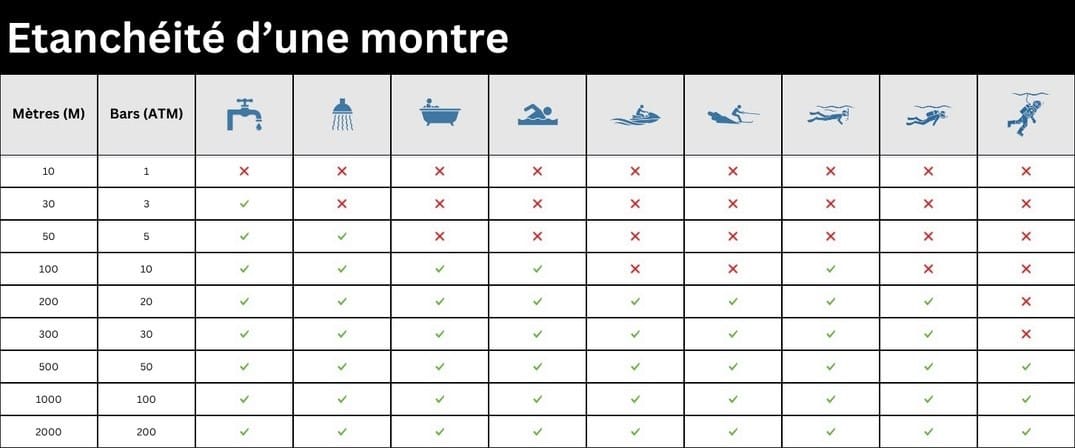
Practical Guide: Which Activity for Which Water Resistance?
Theory is good, but practice is better. Let’s see what your watch can actually endure—or what might kill it—depending on what’s engraved on the back.
“Water resistant”: The Mention That Can Mean Everything and Nothing
If you only see “Water Resistant” or “Étanche” without any associated number, be wary. This is the zero level of protection. Concretely, your accessory barely tolerates a few accidental splashes when washing hands or light rain, nothing more.
Let’s be very direct: any immersion, even brief, is strictly prohibited. Showering is forbidden, as water would immediately infiltrate the mechanism.
The Water Resistance Scale Decoded for Everyday Use
Consider this scale a survival guide for checking watch water resistance before jumping into the water.
- 3 ATM / 3 Bar / 30 meters: It resists everyday hazards like dishwashing, hand washing, rain, or perspiration. Forbidden: showering, bathing, and any form of swimming.
- 5 ATM / 5 Bar / 50 meters: It can withstand a bath or shower (if the water isn’t too hot for the seals). OK for calm surface swimming. Forbidden: diving and water skiing.
- 10 ATM / 10 Bar / 100 meters: Suitable for most water sports. Activities: competitive swimming, sailing, snorkeling. Forbidden: scuba diving with tanks and jet skiing.
Watches Designed for Immersion: 20 ATM and Up
From 20 ATM (200 meters) upwards, we finally enter the serious category of dive watches. These models are specifically designed to handle intensive water sports and recreational diving without flinching under pressure.
This is the minimum technical requirement for diving with tanks. Still, maintain a safety margin relative to the actual depth displayed.
As for models of 30 ATM and above, they are reserved for the elite, particularly for professional saturation diving.
The Harsh Reality: Why “100 Meters” Doesn’t Mean Diving to 100 Meters
Static Pressure vs. Dynamic Pressure: The Real Danger
Understanding watch water resistance requires distinguishing between laboratory tests and reality. The simple act of swimming, diving, or placing your wrist under a powerful shower jet drastically multiplies the pressure exerted on the seals. This is the concept of dynamic pressure.
Take a simple dive as a concrete example to illustrate this risk. The violent impact with water generates a sudden overpressure of several bars on the case in a fraction of a second.
This sudden force is often enough to compromise theoretical water resistance. Your watch takes on water even though it seemed protected.
The Silent Enemies: Thermal Shocks, Salt, and Chlorine
Thermal shock is a silent killer for your mechanism. Moving from a sauna or hot shower to cold water forces the expansion and contraction of the case materials. This phenomenon creates micro-fissures in the seals.
Saltwater and chlorine are just as pernicious for your equipment. These corrosive elements chemically attack the rubber seals in the long term. Always remember to rinse your timepiece with fresh water after every swim in the sea or pool.
The Strap, a Detail That Changes Everything
Wearing a waterproof watch with a leather strap remains an absolute nonsense. This noble material will stain, deform, and eventually degrade quickly upon contact with water.
For your aquatic activities, opt for materials that fear nothing. Choosing a resistant rubber strap or steel then becomes truly essential. This way, you will preserve the style and security of your watch.
Preserving Your Watch’s Water Resistance in the Long Term
Water resistance is not an eternal quality; it requires attention. Here’s how to care for your watch so it lasts for years without ever taking on water.
The Guardians of Your Mechanism: Seals, Crown, and Case Back
The seals located at the crystal, case back, and crown act as the vital organs of water resistance. These rubber or nitrile barriers are effective, but they inevitably wear out and dry over time.
The crown often constitutes the critical weak point. A screw-down crown offers much greater security than a simply pushed crown. You must systematically check that it is fully pushed in or screwed down before any contact with water.
Water Resistance Check: An Appointment Not to Be Missed
Over the years, seals eventually age, dry out, and lose their natural elasticity. Regular inspection of their condition is therefore essential to avoid unpleasant surprises.
I advise you to have the water resistance checked by a professional every 1 to 2 years, and systematically after each battery change. It’s a small smart expense that prevents very significant damage to the mechanism.
Note that this technical check is often automatically included during a complete overhaul of your watch.
What to Do if Fog Appears Under the Crystal?
This is the absolute alarm signal for your watch. The presence of fog means that unhealthy moisture has already settled inside the case.
Here’s the emergency procedure: do not wait. Pull out the crown to stop the mechanism and immediately go to your watchmaker. Every hour counts to save the movement from corrosion, so act very quickly.
In summary, your watch’s water resistance requires vigilance and common sense. Never take the markings literally and be wary of hot water. By respecting these limits and regularly checking your seals, you will effectively protect your mechanism. Your timepiece deserves this attention to last over time.
Some Questions About Water Resistance
The choice of water resistance depends entirely on your lifestyle. If you only keep your watch at the office and take it off for showering, 3 ATM resistance is more than enough. However, if you’re the type to jump into the pool without thinking or keep your timepiece on in the shower, we strongly advise you to opt for a model displaying at least 10 ATM (100 meters) to avoid any unpleasant surprises.
A watch marked 3 ATM (or 30 meters) offers the minimal level of protection. Concretely, it resists accidental splashes when washing your hands, light rain, or perspiration. Be careful, it should never be immersed: forget about dishwashing, showering, and of course, swimming with this type of model on your wrist.
Theoretically, a watch water-resistant to 50 meters (5 ATM) can withstand very calm surface swimming. However, in practice, it’s risky. A simple dive or vigorous arm movements create dynamic overpressure that can compromise the water resistance. For peace of mind while swimming, it is preferable to choose a watch water-resistant to 100 meters (10 ATM).