Manufacture: this single word inspires dreams among lovers of fine timepieces. The manufacture is where everything happens, where the miracle occurs—that of the assembly of the timepiece, of its creation ex nihilo. Of all the forms of enterprise that have set out to manufacture these technological wonders, the watchmaking manufacture is by far the most prestigious, the most recognized… and the most desired. It alone concentrates everything that constitutes the DNA of a high-end timepiece. Without further ado, let us set off together to discover this essential part of the
watchmaking industry.
Attempting to define a watch manufacture
In the collective imagination, the watchmaking manufacture is a kind of village of indomitable Gauls whose self-sufficiency allows it to resist successive Roman invasions. In other words, a manufacture would (theoretically) be a firm that creates its clocks and watches from start to finish, from design to production, without calling upon any outside help, indifferent to the course of the world outside its walls.
However, if this definition were applied stricto sensu, few candidates would manage to earn the supreme title. For a watch manufacture to be truly considered as such, it would need to own its own raw material mines, then design and assemble its components from A to Z (escapement, hairspring, case, etc.), without ever purchasing the slightest screw from a supplier, or having the smallest hand manufactured by a subcontractor.
We shall say, therefore, that a watchmaking manufacture, in its more accessible form, is a company that designs a major part of its components itself—most notably, at a minimum, the entire movement of the watch or clock—and then ensures its assembly. This does not prevent it from ordering a specific part from a specialized company. It is the same difference that exists between a quality restaurateur and a fast-food outlet: the former will prepare their fine dishes themselves, without necessarily growing their own lettuce in their garden. The same applies to the watchmaking manufacture in its most “democratic” definition.
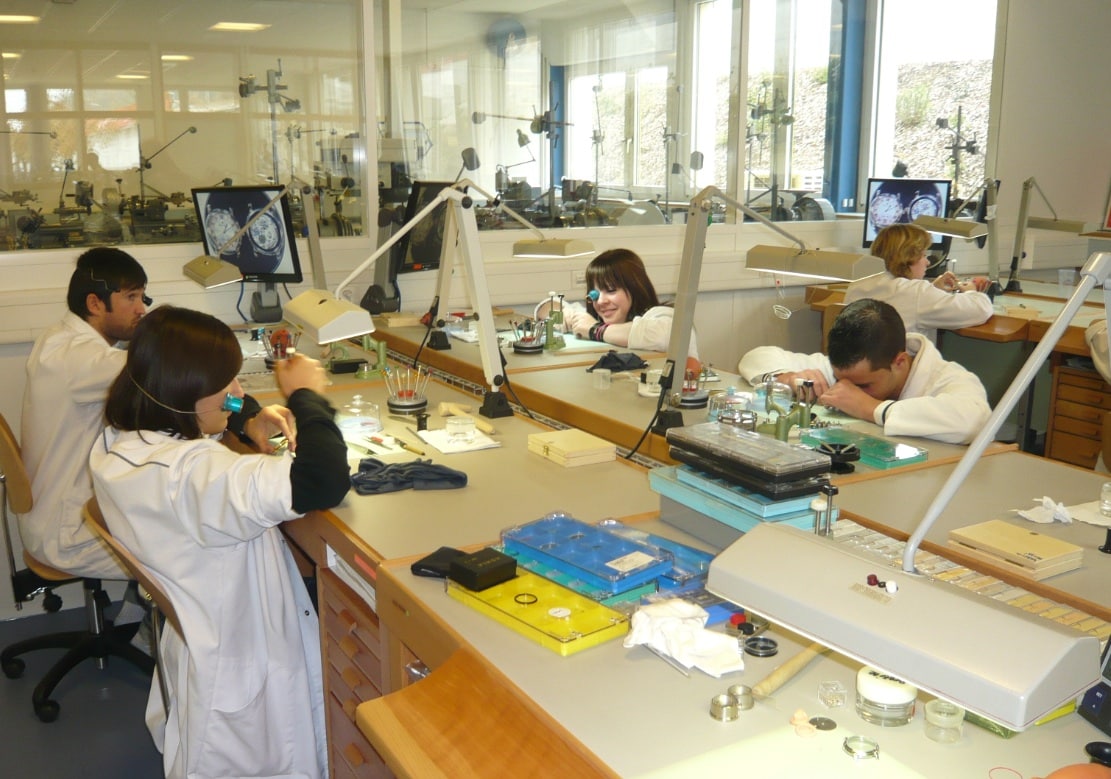 The watchmaking manufacture, epicenter of the watchmaking world
The fact remains that this democratization makes sense—because the idea of a “watchmaking manufacture” generates a certain prestige and adds value to the brands that can claim it. In an increasingly open world, where the progress of globalization tends to blur the notions of origin and product quality, the manufacture is easily elevated to the rank of a qualitative label: a firm that manufactures its own watches, in-house, and oversees its production from start to finish, can thus rely on this added value to optimize its marketing and reach a discerning public. Which, more often than not, means: selling watches at a higher price.
In fact, the watch manufacture has become the epicenter of the horological earthquake that hit the planet a few decades ago. From the 2000s onwards, there was indeed a gold rush aimed, for many market players, at obtaining this designation synonymous with prestige—companies that once contented themselves with casing pre-existing mechanisms, and which transformed over time into full watchmaking manufactures.
This trend coincides with the compartmentalization of the watch market into two distinct entities: on one side, mass-market production, such as quartz watches, which established itself in the 70s. And on the other, timepieces evolving in the high-end and luxury segments—mechanical, and therefore produced by watch manufactures. These models are created for a hand-picked clientele, capable of spending several thousand, or even tens of thousands, of euros.
On the double meaning of manufacture
This is why, in the early years of the new millennium, many brands became fixated on transforming themselves into manufactures, often by acquiring the suppliers and subcontractors they had previously used and bringing them under their own banner—this was the case for Breguet, Breitling, Omega, and Rolex, for example. Others started from scratch, through sheer effort and craftsmanship.
However, make no mistake: the principle of the watchmaking manufacture is not exclusive to luxury timepieces, nor is the manufacture of high-end models necessarily linked to this notion. The Japanese company Seiko, which offers mass-market products at low prices, is a watch manufacture in the strict sense (it has adopted a vertical model that allows it to be totally independent); while a great name such as Vacheron Constantin, one of the most luxurious and oldest brands in operation, sources movements from other manufacturers.
As we can see, the notion is volatile. But the fact remains that the expression “watchmaking manufacture” continues to inspire dreams among lovers of fine watches—and undoubtedly will for a very long time to come.