

Gnomon, sundial, clepsydra, or hourglass… Since the world began, humankind has sought to circumscribe the inexorable passage of time in order to measure its intervals for practical use. Toward the end of the Middle Ages, the narrative of time measurement gave way to a true history of horology when the first mechanisms were installed on steeples and belfries. This was the era of the medieval clock and the birth of mechanical horology, which paved the way for the modern conception of time.
Emmanuel Poulle, in “Pour une typologie de l’horlogerie astronomique médiévale” (to be read in its entirety here), notes that horology experienced extraordinary development in the fourteenth century. He adds that one can perceive its importance by observing the increased usage of the term “horloge,” now employed to designate not the various instruments for measuring time (gnomons and other clepsydras) but rather clocks in the sense understood today.
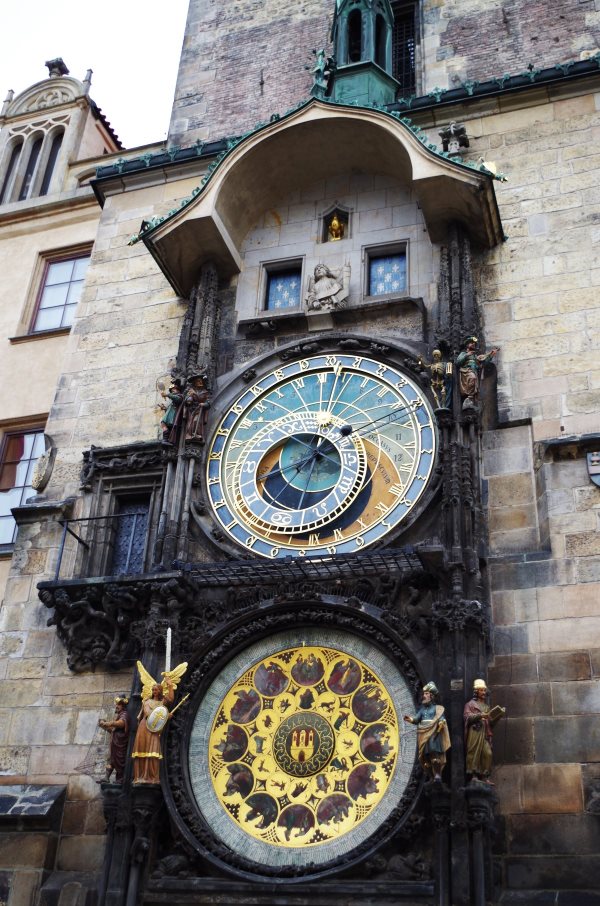
In its early days, mechanical horology, like the “simple” measurement of time before it, was a matter for men of the Church: it was monks who imported the fire clock in order to organize the nocturnal canonical hours, and it was the religious, again, who offered skilled technicians the opportunity to design and construct the first mechanical clocks for installation on the steeples and towers of their churches. At times, these were astronomical clocks capable of measuring the course of the sun across the sky.
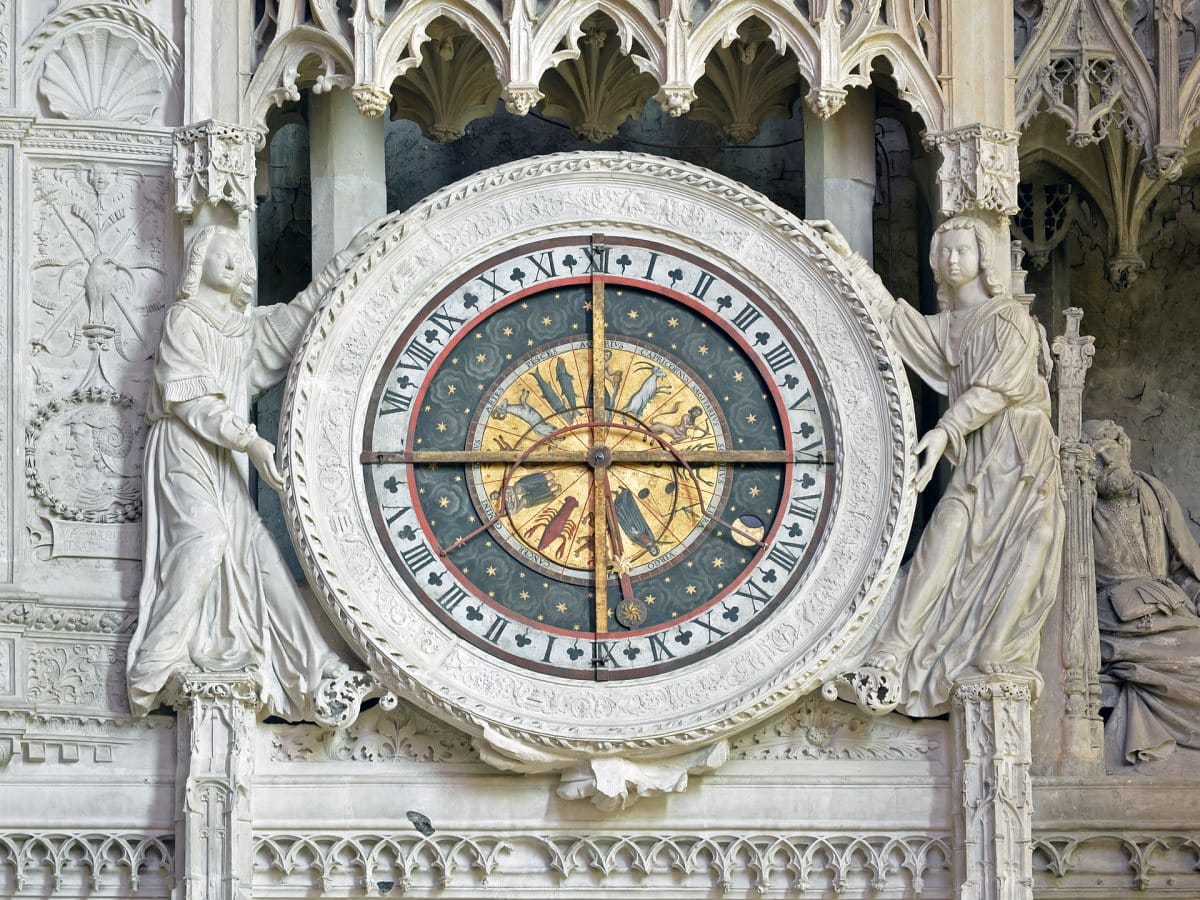 In fact, the first European clocks were designed less to display the time than to sound it. Two types are traditionally identified:
The medieval clock represents a significant change from the time-measuring instruments used until then: by its nature, because it requires the action of a hammer striking a bell, it introduces a new logic. It is no longer sufficient merely to perceive the passage of time; one must also inform the community as to the moment of devotions, and to do so, develop systems capable of sounding the hours.
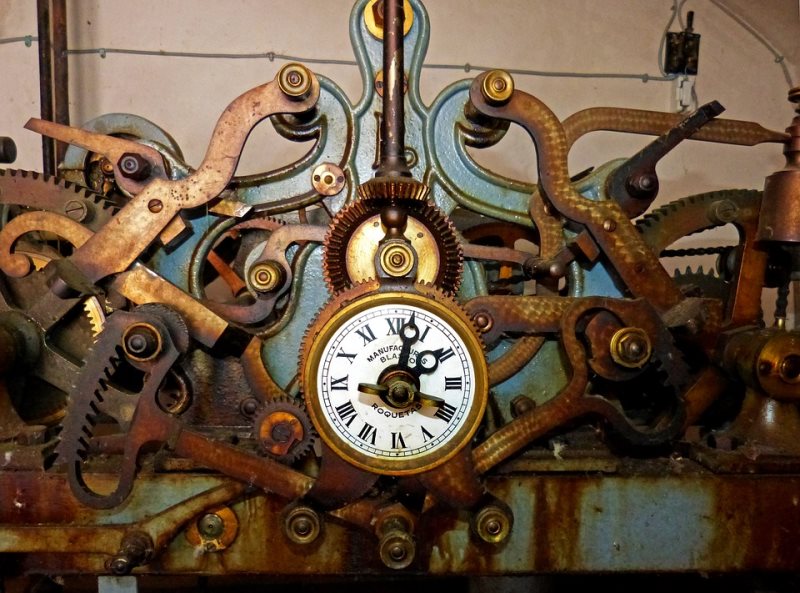
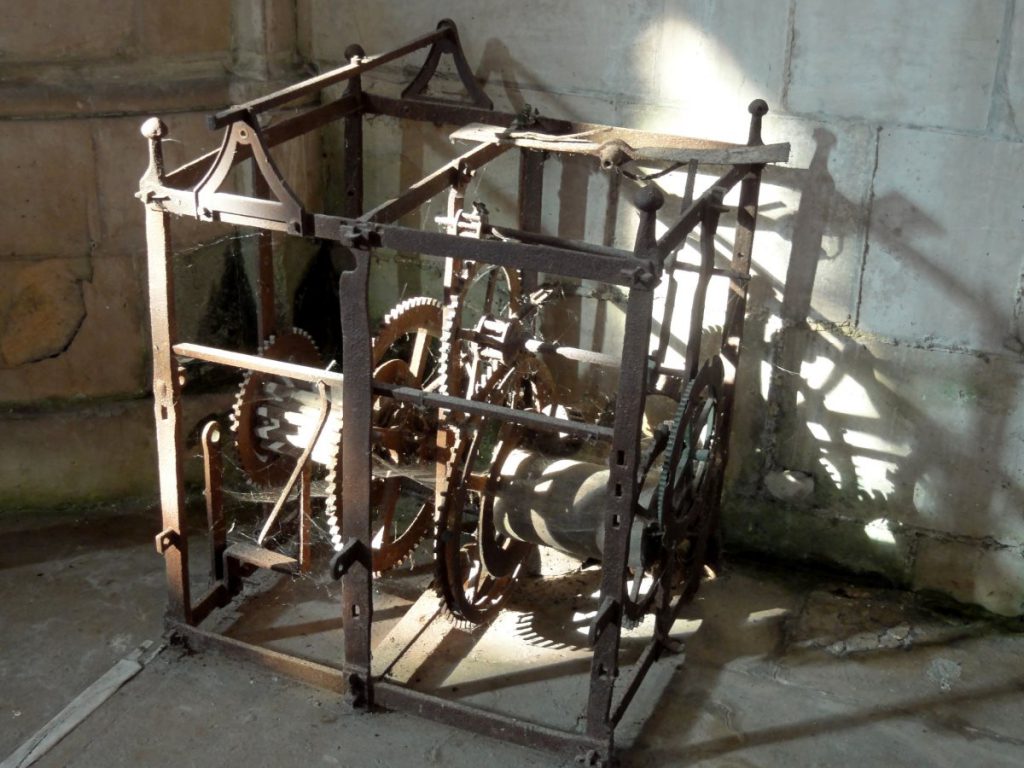
The medieval clock is thus the result of a monastic necessity materialized in the form of a revolutionary invention, albeit in primitive form: the escapement, whose purpose is to control the manner in which the motive force is released to the clock. A mechanical clock can thus operate for hours on end, thanks to the controlled descent of a weight. This capital innovation is nothing other than the birth, properly speaking, of the mechanisms that would pave the way for modern horology.
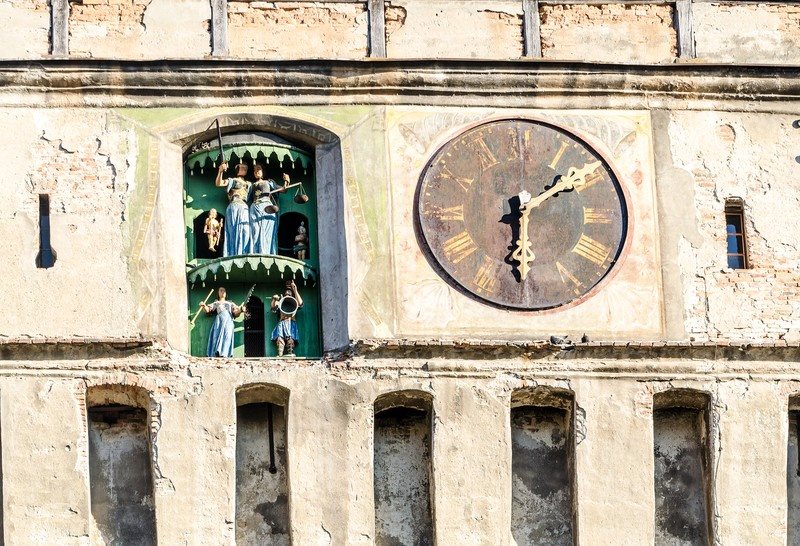
From that point forward, throughout Europe, large clocks were installed atop steeples and belfries. By sounding equal hours, they disseminated a new perception of time. Church towers were transformed into clock towers; steeples became campaniles; the astronomical clock was adorned with astonishing movements and original mechanisms; the passage of time was metamorphosed into a public service, offered to all within the community.
While one cannot speak literally of a “clockmaker” at that time, medieval horology nevertheless possessed its skilled technicians, and until the fifteenth century, it was indeed a profession that slowly took shape, aggregating numerous technical competencies in service of a single purpose. Initially, however, horology remained a secondary activity for those goldsmiths, locksmiths, blacksmiths, and ironworkers who experimented with and invented original mechanisms; they assisted astronomers, geometers, and philosophers seeking to imprison duration within new temporal machines (see on this page).
The fragility of the mechanisms, requiring constant attention, meant that the first true profession related to medieval horology was that of keeper: he took charge, on-site in the town or village, of the maintenance of the local timepiece. Most often, it was the manufacturers who undertook this task: traveling with the entirety of their tools and personnel, forge included, they constructed and installed clocks on public monuments, then returned at regular intervals to ensure their operation within a restricted geographic territory.
But very early on, one witnesses the appearance of the first clockmakers worthy of bearing that name: the Englishman Richard de Wallingford (around 1330) and the Italian Giovanni Dondi (second half of the fourteenth century), both of whom became masters in the art of constructing astronomical clocks. Following these two precedents, a few clockmakers acquired a certain renown; but one must wait until the end of the fifteenth century and the official status granted by Louis XI to the royal clockmakers for mere technical skill to be transformed into a recognized profession, marking, in effect, the end of medieval horology and the beginning of modern horology.
 The medieval clock: a matter of belief
Emmanuel Poulle, in “Pour une typologie de l’horlogerie astronomique médiévale” (to be read in its entirety here), notes that horology experienced extraordinary development in the fourteenth century. He adds that one can perceive its importance by observing the increased usage of the term “horloge,” now employed to designate not the various instruments for measuring time (gnomons and other clepsydras) but rather clocks in the sense understood today.
In its early days, mechanical horology, like the “simple” measurement of time before it, was a matter for men of the Church: it was monks who imported the fire clock in order to organize the nocturnal canonical hours, and it was the religious, again, who offered skilled technicians the opportunity to design and construct the first mechanical clocks for installation on the steeples and towers of their churches. At times, these were astronomical clocks capable of measuring the course of the sun across the sky.
In fact, the first European clocks were designed less to display the time than to sound it. Two types are traditionally identified:
- The chamber clock, or alarm: it was intended for the cell of the clock keeper in the abbey or monastery and rang a bell indicating to the abbot that it was time for prayer.
- The steeple or tower clock: placed at height in monastic establishments or churches, it automatically set in motion the large bell signaling the hour of prayer—the same bell that the attendant had to activate after being prompted by the chamber clock.
 When the measurement of time becomes mechanical
The medieval clock represents a significant change from the time-measuring instruments used until then: by its nature, because it requires the action of a hammer striking a bell, it introduces a new logic. It is no longer sufficient merely to perceive the passage of time; one must also inform the community as to the moment of devotions, and to do so, develop systems capable of sounding the hours.
The medieval clock is thus the result of a monastic necessity materialized in the form of a revolutionary invention, albeit in primitive form: the escapement, whose purpose is to control the manner in which the motive force is released to the clock. A mechanical clock can thus operate for hours on end, thanks to the controlled descent of a weight. This capital innovation is nothing other than the birth, properly speaking, of the mechanisms that would pave the way for modern horology.
From that point forward, throughout Europe, large clocks were installed atop steeples and belfries. By sounding equal hours, they disseminated a new perception of time. Church towers were transformed into clock towers; steeples became campaniles; the astronomical clock was adorned with astonishing movements and original mechanisms; the passage of time was metamorphosed into a public service, offered to all within the community.
 The profession of clockmaker during the medieval period
While one cannot speak literally of a “clockmaker” at that time, medieval horology nevertheless possessed its skilled technicians, and until the fifteenth century, it was indeed a profession that slowly took shape, aggregating numerous technical competencies in service of a single purpose. Initially, however, horology remained a secondary activity for those goldsmiths, locksmiths, blacksmiths, and ironworkers who experimented with and invented original mechanisms; they assisted astronomers, geometers, and philosophers seeking to imprison duration within new temporal machines (see on this page).
The fragility of the mechanisms, requiring constant attention, meant that the first true profession related to medieval horology was that of keeper: he took charge, on-site in the town or village, of the maintenance of the local timepiece. Most often, it was the manufacturers who undertook this task: traveling with the entirety of their tools and personnel, forge included, they constructed and installed clocks on public monuments, then returned at regular intervals to ensure their operation within a restricted geographic territory.
But very early on, one witnesses the appearance of the first clockmakers worthy of bearing that name: the Englishman Richard de Wallingford (around 1330) and the Italian Giovanni Dondi (second half of the fourteenth century), both of whom became masters in the art of constructing astronomical clocks. Following these two precedents, a few clockmakers acquired a certain renown; but one must wait until the end of the fifteenth century and the official status granted by Louis XI to the royal clockmakers for mere technical skill to be transformed into a recognized profession, marking, in effect, the end of medieval horology and the beginning of modern horology.