Labels and certifications concerning watches and movements are essential for the
watchmaking industry. For timepiece enthusiasts, of course, who are sensitive to prestigious watch labels that validate high technical quality. But even more so for manufacturers, as obtaining a watchmaking label or certification has become a guarantee of expertise and authenticity, consolidating the reputation of high-end production. We invite you to discover the various existing distinctions – particularly Swiss ones.
The Watch Label: An Essential Quality Reference
At the origin of every watch label and watchmaking certification is the foremost Swiss distinction: the
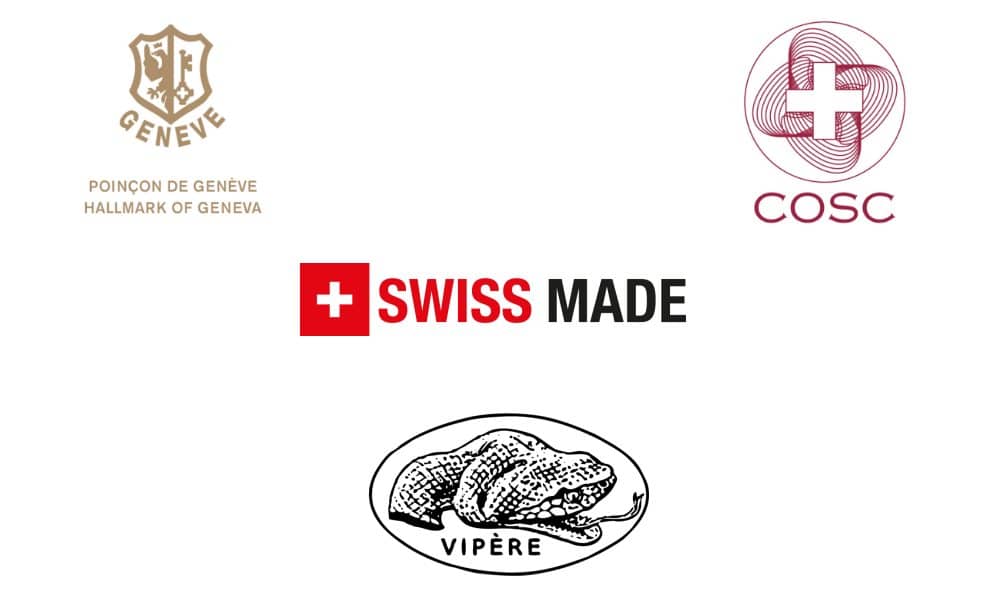
Swiss Made. This watchmaking label, affixed to timepiece dials, was intended to certify the quality of materials and the expertise of watchmakers at a time (the late 19th century) when counterfeits became increasingly prevalent.
The problem, at the time, was not new. The question of origin has piqued consciences since the beginnings of large-scale watchmaking: from the late 18th century, artisans more cunning than others signed their mechanisms with the names of renowned master watchmakers – this allowed them to sell their production more quickly while reassuring buyers – and readily lied about manufacturing locations, preferring to cite cities known for their watchmaking quality. But as it developed, this system began to seriously threaten production – hence the officialization of the Swiss Made watch label to indicate a Swiss origin.
From then on, watch certification became a guarantee of quality and controlled origin. Many territories launched their own watch label, in Switzerland and elsewhere: the most famous are undoubtedly the
Poinçon de Genève (Geneva Seal), instituted by the Société des Horlogers de Genève and the State Council in 1886; and the Poinçon vipère (Viper’s Head), created by the Besançon Observatory in 1897. This type of watch certification aims to protect local expertise and guarantee buyers the possession of a high-quality product, genuinely manufactured locally.
 Watchmaking Certification Proliferates
Indeed, this need, which emerged from the very beginnings of watchmaking industrialization, has only continued to strengthen with the evolution of the sector and the global market, pushing the field of watch certification to transform with them. A good example is what happened with Swiss Made: this distinction, which suffered no questioning, was challenged by Swiss manufacturers themselves starting in the 1980s, as parts manufactured in Asia at lower cost began to infiltrate the cases of Swiss timepieces by exploiting loopholes in the 1971 ordinance. The result: it became necessary to evolve and consolidate this watch label so that it retained its full value.
In the wake of this, other certifications were born – partly due to the distrust caused by doubts about the criteria defined by Swiss Made, and partly because brands wished to highlight their own production. In the municipality of Val-de-Travers, four independent watch brands launched a watch label in 2004, issued by the
Fondation Qualité Fleurier, with the particularity that it distinguishes finished models. For its part, the Patek Philippe brand, based in Geneva, seceded to launch its own Seal – with its own control criteria. As for Jaeger-LeCoultre and Montblanc, they developed internal control processes for their movements.
Furthermore, there are also professional tests conducted by independent workshops, such as the Chronofiable by Dubois S.A. laboratory in La Chaux-de-Fonds, which involves advanced analyses of movements (under development or nearly finished) with the aim of validating brand choices. The watch label issued by the FQF also requires passing these tests.
Precision and Reliability: Chronometer Certification
However, no matter how demanding a watch label may be, it cannot always guarantee the precision and reliability of a movement. For this, there is an entirely different kind of watchmaking certification: the chronometer label. This title is awarded by associations independent of brands, known as “control offices,” the most famous of which is undoubtedly the
COSC, or Official Swiss Chronometer Testing Institute. The Besançon Observatory, which affixes the
Poinçon vipère, is also authorized to issue a rate certificate.
Chronometer certification is highly sought after by high-end manufacturers – Omega, Rolex, Breitling, and others – who submit all or part of their movements for extremely rigorous tests. These aim to measure the deviation between the movement and the reference time, up to a half-second difference.
In conclusion, it should be noted that the concept of a watch label is necessarily evolving, as the standards in force at any given moment, both in terms of technical quality and aesthetics, are subject to change and may no longer be accepted as they are by brands. While watch certification remains an equally valuable key, favored by manufacturers because it constitutes a form of guarantee to present to the consumer (and because it allows for an increase in the selling price of a timepiece), the trend is towards the creation of exclusive brand-specific labels, guaranteeing their internal quality.