

After being invented in Asia, the fire clock—also known as a combustion clock—reached Europe around the 8th century CE. Replacing the hourglass, which had to be turned at regular intervals, it made it possible to measure time by using a fuel whose burn was both slow and uniform, and therefore predictable—either a candle or oil contained in a lamp. Let us explore the history of this clock.
It was in Asia that the fire clock first appeared, particularly in China—Japan adopted it later. Evidence of its use dates back as far as the 6th century BC.
The principle is simple: sticks coated with a combustible paste are used—what we would today call incense. Because it burns at a fixed rate, incense is an excellent indicator of time passing. The stick is placed on a horizontal support, most often a hollow lacquer object. As it burns, the incense stick passes graduations that make it possible to calculate the time elapsed.
Another way of marking the hours is to place, at regular intervals along the stick, weighted silk threads on either side, with small suspended masses (typically metal beads). When the burn reaches a thread, it burns through and releases the masses, which fall into a metal receptacle, producing a recognisable sound. In this way, not only did the Chinese invent the chronometer (the calculation of a relatively precise duration, represented by the length of the incense stick), they also devised the alarm clock!
With the aesthetic care characteristic of ancient China, the lacquer supports of incense clocks, on which the sticks are placed, are anything but crude containers. The archetypal model is what is known as a dragon boat: a base shaped like a vessel, whose bow and stern represent the head and tail of a dragon. Around the support, two containers collect the beads held by the silk threads.
The fire clock arrived in Europe in the 8th century, possibly adopted (or reinvented?) by a monk who needed a time-measurement system to count the night hours between each prayer. The combustible stick of the Chinese incense clock was replaced by a candle, one metre high, regularly graduated to mark the hours. In this way, the candle’s burn indicates the number of hours elapsed, with accuracy depending on several criteria: the candle’s regularity, the quality of the wax, the thickness and spacing of the marks, and, of course, any draughts.
In fact, the earliest uses of the fuel-based clock were reserved for religious congregations, so that they could observe prayer times during the night as accurately as possible. Three one-metre candles are generally required to reach dawn. This device nevertheless spread rapidly throughout medieval Europe.
The candle has therefore always been a symbol of duration flowing by, and its combustion a representation of time slipping away—right up to the present day, when we still blow out candles to celebrate birthdays. Before the invention of the oil lamp, the candle was used in the theatre to light the stage and the actors—the length of an act was thus conditioned by the candle’s burn time. In the Middle Ages, it also became a symbol of wealth: the wax candle, more luxurious than its tallow equivalent, was the preserve of wealthy families. And it could not be used as a fire clock in the least well-off households, which had to preserve it for as long as possible.
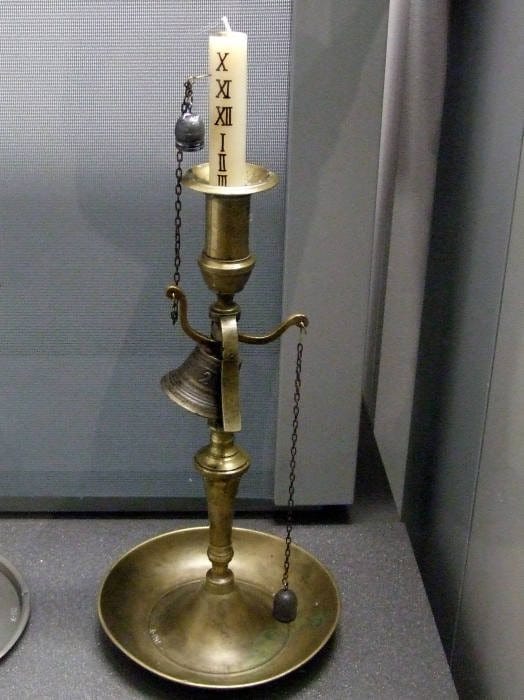 The Fire Clock: a Celebrated System
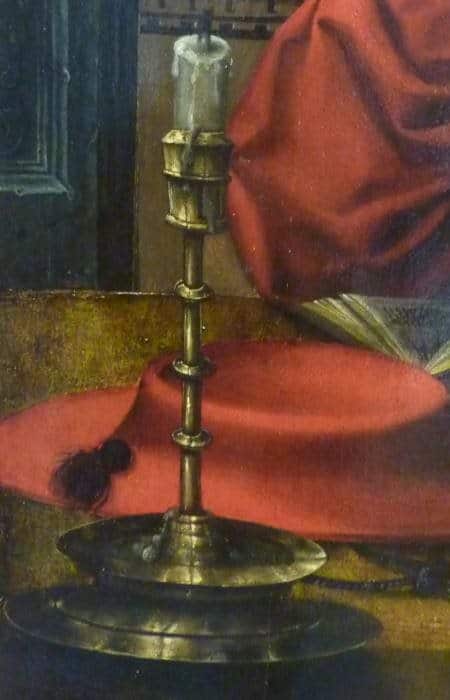 Measuring Time by Candle