

Built at the western end of Lake Geneva, Geneva stands out as a true “global city”, given its economic and political role. However, the second most populous municipality in Switzerland is also the cradle of luxury watchmaking, which emerged in the mid-16th century and has never since left the Jura arc. Follow us into the heart of this city where Time itself seems to have made its home.
To witness the birth of Geneva’s watchmaking industry, one must go back to the mid-16th century. At that time, the city benefited from an influx of French and Italian Protestants fleeing religious persecution, who brought new dynamism, notably in silk-making, gilding and watchmaking.
John Calvin, who welcomed these Huguenot refugees, was indirectly behind the expansion of watchmaking in the city. Keen to extend his desire for austerity to everyone, he banned the wearing of decorative objects as jewellery, seeing them only as superfluous accessories of seduction. This decision pushed goldsmiths, forced into unemployment, to retrain in watchmaking: they then set watch cases with precious stones, creating objects that escaped Calvinist wrath. This professional exodus marked the birth of luxury watchmaking in the city.
From Geneva, Swiss watchmaking spread across the entire Jura arc as far as Schaffhausen over the following century. The revocation of the Edict of Nantes by Louis XIV in 1685, nearly ninety years after the act of tolerance granted by Henry IV, accelerated the arrival in the region of Huguenots fleeing France. Among them, craftsmen found workers who displayed all the qualities essential to making clocks—patience and meticulousness, integrity and perseverance, virtues encouraged by the expansion of the Reformation. Watchmaking in Geneva naturally benefited from this meeting of talents.
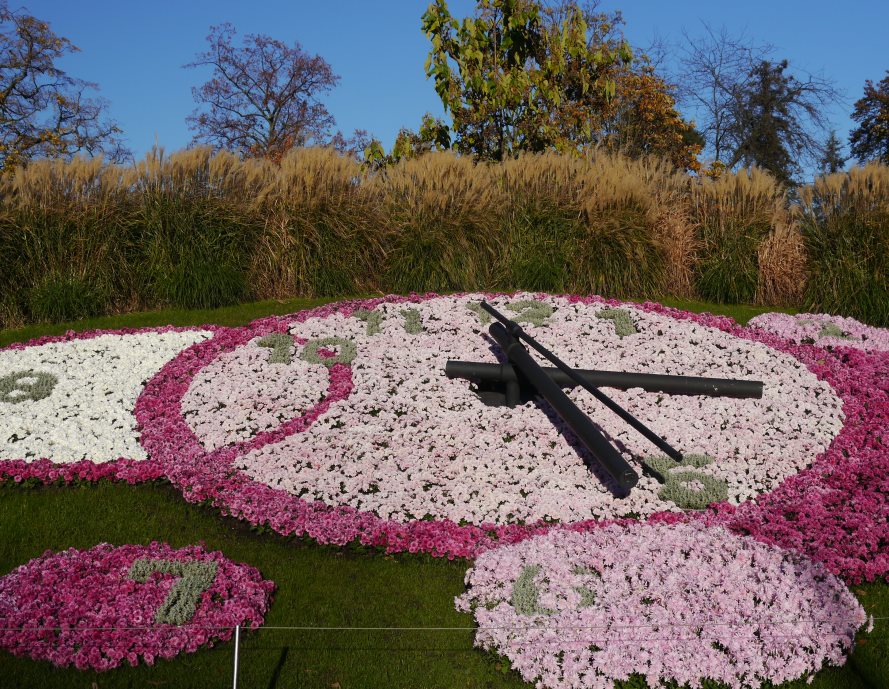
Watchmaking in Geneva is not merely a vague legacy explored only in history books. No, this field is very much alive, and this international “global city” has a heart that continues to beat to the rhythm of a (Swiss) watch. The best symbol of this is undoubtedly the Flower Clock, a decorative dial made entirely of flowers, visible in the English Garden since it was created in 1955 by the city’s Parks and Promenades Department: a vivid expression of Geneva’s past, as well as its residents’ very contemporary taste for fine craftsmanship.
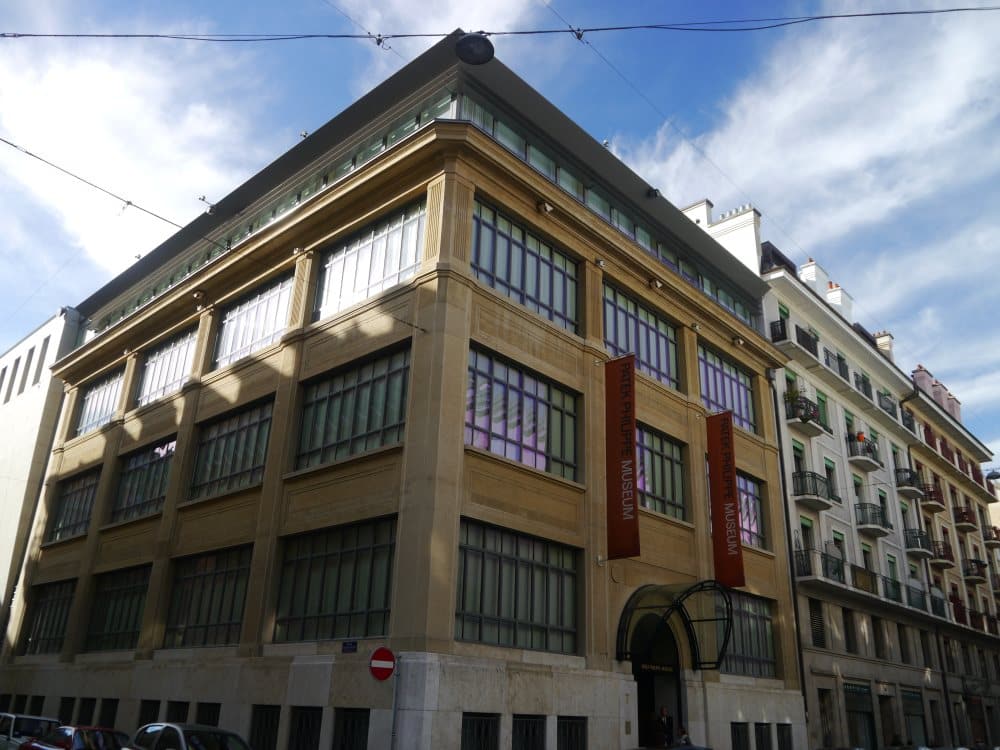
Other landmarks confirm the metropolis’s watchmaking dimension: its Museum of Watchmaking and Enamelling, which exhibits watch models made in Switzerland and across Europe. Its Patek Philippe Museum, founded by the company’s president, Philippe Stern, in 1989, following the success of the presentation of some 500 models from the maison on the occasion of its 150th anniversary. Or the Cité du Temps, part of an 1840 building purchased by the Swatch Group in 2005 to make it a permanent exhibition space, both for the brand and for other watchmaking creations from around the world.
In addition to the major Swiss watch brands headquartered in Geneva (Alpina, Baume & Mercier, Chopard, Patek Philippe, Piaget, the Richemont Group, Rolex, Vacheron Constantin—nothing less!), the city has a huge number of luxury watch boutiques, notably along Rue du Rhône—the local Champs-Élysées. It also has two schools dedicated to this art: the Geneva Watchmaking School, a public institution founded in 1824, and the CFH (Training Centre in the field of watchmaking), located precisely in Plan-les-Ouates, in Geneva’s immediate suburbs.
Finally, the city also hosts, every year, the Salon International de la Haute Horlogerie. A very private event that, for nearly thirty years, has brought together industry professionals in what was, is, and will remain, the central pivot of fine watchmaking.
 The place of watchmaking in Geneva
 A city that lives to the rhythm of watchmaking